

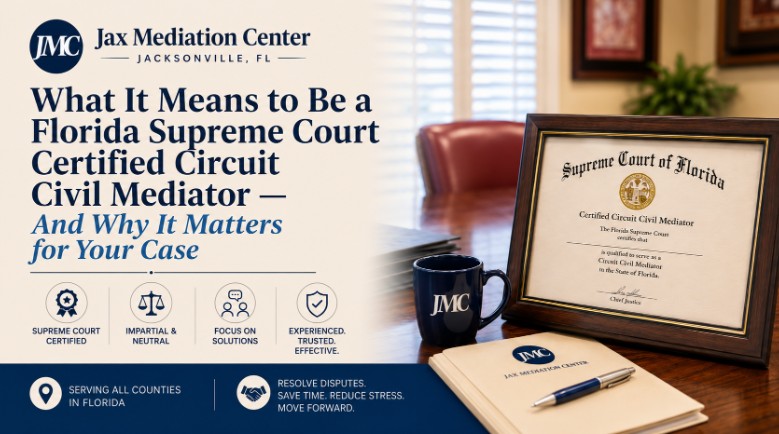
A Florida Supreme Court Certified Circuit Civil Mediator has satisfied the Florida Dispute Resolution Center’s certification system and completed a Florida Supreme Court-approved circuit civil mediation training program.
Certification also requires mentorship under a certified mediator and ongoing ethical oversight under Florida Rule for Certified and Court-Appointed Mediators 10.100 (2025).
Certification authorizes the mediator to conduct court-ordered mediations in Florida circuit civil cases involving disputes above $50,000. Schmidt at Jax Mediation Center in Jacksonville has held that certification since 2003.
Parties in circuit civil disputes who require a private mediator select from the pool of Florida Supreme Court-certified mediators
The National Academy of Distinguished Neutrals is an invitation-only professional organization that imposes practice requirements on mediator members that exceed Florida Supreme Court certification standards.
Where Florida DRC certification is an entry-level credential that authorizes a mediator to conduct court-ordered sessions, NADN membership signals that the mediator has sustained a high-volume, peer-recognized practice over the years, not simply passed a qualification threshold.
NADN membership for mediators requires all 4 of the following under the Academy’s published membership standards: a minimum of 5 years in civil and commercial ADR practice with at least 30 percent of professional efforts dedicated to ADR work; remuneration for ADR practice for a minimum of 60 days annually; completion of at least 200 private civil mediations, excluding pro bono and family law cases; and nomination by 2 existing Academy members who vouch for the nominee’s standing among the legal community.
The Academy roster locks annually, with new members inducted in January following a due diligence review conducted under the guidance of each state’s NADN committee.
A newly certified mediator with 5 sessions and a mediator with 200 completed private civil disputes carry the same DRC certification credential on paper.
NADN membership distinguishes the latter — the 200-dispute minimum ensures that NADN members have navigated the full range of impasse patterns, multi-party dynamics, and settlement structure complexity that only volume produces.
Parties in high-value personal injury, commercial, and construction cases who select a mediator use NADN membership as a filtering criterion precisely because it cannot be purchased or self-designated.
The Florida Circuit-Civil Mediators Society (FCCMS) is the Florida chapter of the National Academy of Distinguished Neutrals, formed in 2004 as the state’s peer-nomination body for attorney-mediators in civil and commercial practice.
FCCMS membership applies the same 200-dispute minimum, 5-year civil and commercial ADR practice floor, and dual peer-nomination requirement as the national NADN organization — but vets nominees specifically against Florida’s civil and commercial ADR community, where the relevant reputation is built.
FCCMS membership requires that a nominee be known and respected by Florida litigation firms — not just certified by the state.
The organization’s published membership standards specify that nominees must be nominated and seconded by 2 existing Florida FCCMS members, undergo due diligence review by the Florida state committee, and be recognized as among the most in-demand neutrals within Florida’s circuit civil practice community.
The FCCMS website — floridamediators.org — serves as a scheduling directory used by more than 8,000 Florida law firms to select and book mediators for more than 100,000 cases annually, per FCCMS-published data.
The Florida Academy of Professional Mediators (FAPM) is a separate Florida ADR membership organization that does not impose the 200-dispute minimum or dual peer-nomination requirement imposed by FCCMS and NADN.
FAPM serves a larger membership base of certified Florida mediators across all practice categories.
FCCMS membership is the narrower, more selective designation — limited to attorney-mediators in civil and commercial practice who have been nominated by existing Florida FCCMS members and vetted against the Florida litigation community’s standards.
Schmidt earned circuit civil mediator certification in 2003, following 11 years of Florida Bar membership and 30 years of active civil trial litigation practice in Fort Myers and Jacksonville, Florida.
Schmidt also holds certification as a Mediator for the U.S. District Court, Middle District of Florida, and has served as a Special Master and Umpire in Florida circuit court proceedings.
Schmidt has held a Martindale-Hubbell AV Peer Review Rating continuously since 1997. Martindale-Hubbell AV Rating — designated AV Preeminent — requires a minimum of 10 years of bar admission, a threshold number of peer evaluations from fellow attorneys and members of the judiciary rating the attorney at the highest level of legal ability, and a Very High General Ethical Standards rating reflecting adherence to professional conduct standards.
Approximately 10 percent of all rated attorneys in the United States hold AV Preeminent status under Martindale-Hubbell’s published peer-review criteria.
Schmidt holds active memberships in 3 ADR professional organizations that impose independent vetting standards beyond those of the Florida DRC certification.
The National Academy of Distinguished Neutrals — invitation-only, 200-dispute minimum, 2-member nomination requirement, 5-year civil and commercial ADR practice floor, annual due diligence review.
The Florida Circuit-Civil Mediators Society — Florida chapter of NADN, peer-nominated by existing Florida FCCMS members, vetted against Florida litigation community standards, listed on floridamediators.org for scheduling by Florida law firms.
The Florida Academy of Professional Mediators — Florida statewide ADR membership organization for certified Florida mediators in active practice.
Schmidt also serves as a Volunteer Mediator and Arbitrator for the Florida Bar Grievance Mediation and Fee Arbitration Program, holds membership in the Jacksonville Bar Association and the Jacksonville Women’s Lawyers Association, and served as both Chair and Vice-Chair of the ADR Section of the Jacksonville Bar Association.
Florida Supreme Court circuit civil mediator certification establishes legal authority to conduct court-ordered mediations in Florida. NADN and FCCMS membership establishes that the mediator has sustained a high-volume, peer-recognized practice that the legal community trusts for its most significant cases.
The Martindale-Hubbell AV Peer Review Rating indicates that fellow attorneys and judges have evaluated the mediator’s legal ability and ethical standards at the highest available level.
Schmidt holds all three credential layers simultaneously — active certification, peer-organization membership, and a peer-assessed legal ability rating maintained without interruption since 1997. Attorneys and parties scheduling landlord-tenant and civil disputes can schedule directly with Jax Mediation Center at (904) 224-7044.
What is a Florida Supreme Court Certified Circuit Civil Mediator?
A Florida Supreme Court Certified Circuit Civil Mediator has earned certification from the Florida Dispute Resolution Center by complying with their certification standards, a Florida Supreme Court-certified training program, structured mentorship hours, a criminal background check, and demonstrating good moral character under Florida Rule for Certified and Court-Appointed Mediators 10.100 (2025).
Why does Florida Supreme Court circuit civil mediator certification matter for a civil case?
Florida Rule of Civil Procedure 1.700 (2025) requires mediation in most circuit civil cases before trial, and courts appoint only Florida Supreme Court-certified mediators for those sessions.
What are the requirements to join the National Academy of Distinguished Neutrals?
NADN membership requires a minimum of 5 years in civil and commercial ADR practice, at least 200 completed private civil mediations, dedication of 30 percent or more of professional efforts to ADR work, remuneration for ADR practice of at least 60 days annually, and nomination by 2 existing Academy members who vouch for the nominee’s standing.
What is the Florida Circuit-Civil Mediators Society, and how does membership differ from DRC certification?
The Florida Circuit-Civil Mediators Society is the Florida chapter of the National Academy of Distinguished Neutrals, formed in 2004. FCCMS membership requires nomination by 2 existing Florida members, 200 completed private civil mediations, 5 years of civil and commercial ADR practice, and due diligence review — requirements that exceed Florida DRC certification standards.
What does Martindale-Hubbell AV Peer Review Rating mean for a mediator?
Martindale-Hubbell AV Preeminent Rating requires a minimum of 10 years of bar admission, a threshold number of peer evaluations from attorneys and judges rating the recipient at the highest level of legal ability, and a Very High General Ethical Standards rating. Approximately 10 percent of all rated attorneys in the United States hold AV Preeminent status.
How long has Penny W. Schmidt held a Florida Supreme Court circuit civil mediator certification?
Schmidt has held circuit civil mediator certification since 2003, with more than 20 years of active certified practice. Schmidt earned that certification after 11 years of Florida Bar membership and 30 years of civil trial litigation in Fort Myers and Jacksonville before transitioning to full-time mediation at Jax Mediation Center.
What is the difference between the Florida Academy of Professional Mediators and the Florida Circuit-Civil Mediators Society?
The Florida Circuit-Civil Mediators Society requires peer nomination by 2 existing FCCMS members, a minimum of 200 completed private civil mediations, and 5 years of civil and commercial ADR practice. The Florida Academy of Professional Mediators is a broader statewide organization for certified Florida mediators that does not impose the 200-dispute minimum or dual peer-nomination requirement.
Where can attorneys verify a Florida mediator’s certification status?
The Florida Supreme Court Dispute Resolution Center maintains a publicly searchable online directory at flcourts.gov that shows each mediator’s current certification status, case-type authorizations, and renewal dates. The directory reflects active standing in real time and is the authoritative source Florida courts, attorneys, and parties use to confirm mediator certification before selection or appointment.