


Attorneys in Jax/Duval and throughout Florida who refer cases to a Florida Supreme Court Certified Circuit Civil Mediator protect clients from enforceability challenges, gaps in ethical oversight, and the appellate risk posed by uncertified mediators.
Jax Mediation Center provides certified mediation for personal injury, business, construction, and landlord-tenant disputes in Jax/Duval and throughout Florida.
Penny W. Schmidt, a Florida Supreme Court Certified Circuit Civil Mediator with more than 30 years of civil trial litigation experience, holds NADN membership, FCCMS peer nomination, and peer review credentials exceeding base certification.
Florida’s Fourth Judicial Circuit appoints only certified mediators for court-ordered sessions under § 44.102 of the Florida Statutes.
Referring a client to an uncertified mediator creates enforceability risk and strips the settlement of the procedural protections Florida’s certification framework provides. Schedule mediation with Penny W. Schmidt at (904) 224-7044.
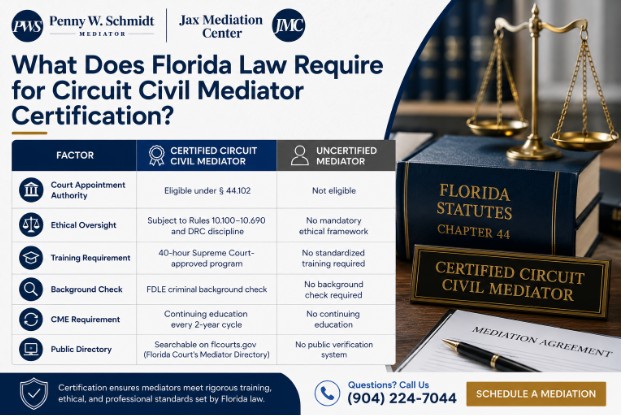
A Florida Supreme Court Certified Circuit Civil Mediator is a neutral third party authorized by the Florida Dispute Resolution Center to conduct court-ordered mediations in circuit civil cases involving claims above $50,000.
Certification confirms that the mediator has completed a Florida Supreme Court-approved training program, structured mentorship hours, and ongoing ethical compliance under Florida Rule 10.100.
The certification distinction matters to referring attorneys because Florida courts under § 44.102 appoint only certified mediators for court-ordered sessions.
An uncertified mediator cannot receive a court appointment, which means any mediation conducted by an uncertified neutral is voluntary and lacks the procedural framework provided by court-ordered mediation.
The Florida Dispute Resolution Center maintains a publicly searchable directory of all certified mediators, allowing attorneys to verify certification status, case-type authorizations, and renewal dates before making a referral.
Florida law requires circuit civil mediator candidates to satisfy the Florida Dispute Resolution Center’s multi-step certification process under Chapter 44, Florida Statutes, and Florida Rule for Certified and Court-Appointed Mediators 10.100.
The process includes completion of a Florida Supreme Court-approved 40-hour circuit civil mediation training program, structured mentorship under a certified mediator, a criminal background check through the Florida Department of Law Enforcement, and demonstrated good moral character.
Certified mediators must also complete continuing mediator education hours during each two-year certification cycle to maintain active status. The DRC monitors compliance and can suspend or revoke certification for ethics violations, failure to meet CME requirements, or conduct that falls below the standards established in Rules 10.200 through 10.690.
The table below compares the oversight framework for certified and uncertified mediators in Florida.
| Factor | Certified Circuit Civil Mediator | Uncertified Mediator |
| Court Appointment Authority | Eligible under § 44.102 | Not eligible |
| Ethical Oversight | Subject to Rules 10.100–10.690 and DRC discipline | No mandatory ethical framework |
| Training Requirement | 40-hour Supreme Court-approved program | No standardized training required |
| Background Check | FDLE criminal background check | No background check required |
| CME Requirement | Continuing education every 2-year cycle | No continuing education |
| Public Directory | Searchable on flcourts.gov | No public verification system |
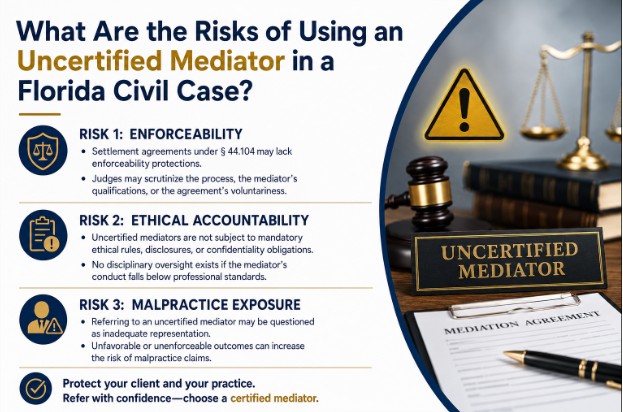
Referring attorneys who send clients to an uncertified mediator expose the settlement to three categories of risk: enforceability challenges under § 44.104, absence of ethical oversight under Rules 10.100 through 10.690, and potential malpractice liability for the referring attorney.
An uncertified mediator operates outside the regulatory framework established by Florida’s certification system.
The first risk is enforceability. Mediated settlement agreements under § 44.104 carry specific enforceability protections when conducted by a certified mediator in compliance with Chapter 44 procedures.
A settlement reached through an uncertified mediator may face judicial scrutiny if either party challenges the process, the mediator’s qualifications, or the agreement’s voluntariness.
The second risk is ethical accountability. Certified mediators are subject to mandatory conflict-of-interest disclosures, confidentiality obligations, and self-determination protections under the Florida Rules for Certified and Court-Appointed Mediators.
Uncertified mediators face no comparable mandatory framework, leaving referring attorneys without a disciplinary mechanism if the mediator’s conduct falls below professional standards.
The third risk is malpractice exposure for the referring attorney. An attorney who refers a client to a mediator with no verifiable credentials, no ethical oversight, and no authority to be court-appointed may face questions about the adequacy of that referral if the mediation produces an unfavorable or unenforceable outcome.
Attorneys referring across all practice areas eliminate this exposure by selecting certified mediators with verifiable credentials.
Selecting an uncertified mediator exposes the settlement to enforceability challenges and the referring attorney to professional scrutiny. Schedule mediation with Penny Schmidt at (904) 224-7044.
Penny Schmidt holds three credential layers that referring attorneys use to evaluate mediator qualifications: Florida Supreme Court circuit civil mediator certification since 2003, National Academy of Distinguished Neutrals membership, and a Martindale-Hubbell AV Peer Review Rating maintained since 1997.
Each layer independently verifies a different dimension of professional competence.
Circuit civil certification confirms that the mediator has completed the DRC’s training, mentorship, and ethical compliance requirements.
Florida Bar membership since 1992 and 30 years of civil trial litigation provide the courtroom perspective that allows her to frame settlement discussions around probable trial outcomes rather than aspirational positions.
Schmidt also holds certification as a Mediator for the U.S. District Court, Middle District of Florida, and has served as a Special Master and Umpire in Florida circuit court proceedings.
Attorneys handling personal injury cases use these credentials as filters when selecting a mediator for high-value or complex disputes.
Association memberships provide referring attorneys with independent vetting signals that go beyond state certification. The National Academy of Distinguished Neutrals, the Florida Circuit-Civil Mediators Society, and the Florida Academy of Professional Mediators each impose different admission criteria that attorneys use to distinguish high-volume, peer-recognized mediators from newly certified practitioners.
The table below compares the three organizations’ membership requirements.
| Organization | Minimum Disputes | Practice Floor | Peer Nomination | Annual Vetting |
| NADN | 200 private civil | 5 years civil/commercial ADR | 2 existing members | Annual due diligence |
| FCCMS (FL chapter of NADN) | 200 private civil | 5 years civil/commercial ADR | 2 existing FL members | Florida committee review |
| FAPM | None specified | Active FL certification | None required | None specified |
NADN membership requires a minimum of 200 completed private civil mediations, 5 years of civil and commercial ADR practice, remuneration for ADR work of at least 60 days annually, and nomination by 2 existing Academy members.
The FCCMS scheduling directory at floridamediators.org serves more than 8,000 Florida law firms booking mediators for over 100,000 cases annually.
Referring attorneys use NADN and FCCMS membership as a shorthand for mediator quality because the 200-dispute minimum and peer-nomination requirement cannot be purchased, self-designated, or circumvented.
A mediator listed in the FCCMS directory has been vetted by members of the Florida litigation community.
Schmidt holds active memberships in all three organizations, providing the maximum available layer of independent verification.
Attorneys referring business disputes, construction cases involving multi-party claims, and landlord-tenant disputes in commercial properties use these membership signals alongside certification status when selecting a neutral for complex cases in Jax/Duval and throughout Florida.
Can a Florida Court Enforce a Settlement Reached Through an Uncertified Mediator?
Florida courts enforce mediated settlement agreements under § 44.104 when the mediation complies with the procedural requirements of Chapter 44. A settlement reached through an uncertified mediator may face judicial scrutiny of the mediator’s qualifications, compliance with process requirements, and whether the agreement satisfies statutory enforceability standards.
How Does an Attorney Verify a Mediator’s Certification Status in Florida?
The Florida Dispute Resolution Center maintains a publicly searchable online directory at flcourts.gov showing each mediator’s current certification status, case-type authorizations, and renewal dates. Referring attorneys can also verify NADN and FCCMS membership through the organizations’ published directories at nadn.org and floridamediators.org.
What Is the Difference Between NADN Membership and Florida DRC Certification?
Florida DRC certification is the entry-level credential authorizing court-ordered mediation. NADN membership requires a minimum of 200 disputes, 5 years of civil and commercial ADR practice, and nomination by 2 existing Academy members, thereby imposing practice volume and peer recognition requirements that exceed state certification standards.
Does Florida Require Mediation Before Trial in Circuit Civil Cases?
Florida Rule of Civil Procedure 1.700 requires mediation in most circuit civil cases before trial. Fourth Judicial Circuit judges order mediation under § 44.102 and appoint only Florida Supreme Court-certified mediators; therefore, uncertified mediators cannot conduct court-ordered sessions in Jax/Duval or anywhere in Florida.
What Ethical Rules Govern Certified Mediators in Florida?
Florida Rules for Certified and Court-Appointed Mediators 10.200 through 10.690 establish mandatory ethical standards covering impartiality, conflict-of-interest disclosure, confidentiality, party self-determination, and professional conduct. The Florida Dispute Resolution Center enforces these rules and can suspend or revoke a mediator’s certification for documented ethical violations.
Can a Certified Mediator Also Serve as an Arbitrator in the Same Case?
Florida mediator ethics rules prohibit a certified mediator from serving as an arbitrator in the same dispute unless all parties provide informed, written consent after the mediation concludes. Penny Schmidt holds both mediator certification and arbitrator training, but separates the two roles in distinct proceedings.
How Does a Martindale-Hubbell AV Rating Relate to Mediator Selection?
The Martindale-Hubbell AV Preeminent Rating requires 10 years of bar admission and peer evaluations from attorneys and judges who rate the recipient at the highest level of legal ability. Approximately 10 percent of rated attorneys hold AV status, making the rating a filtering criterion for mediator selection.
What Happens if a Certified Mediator Violates Florida’s Mediator Ethics Rules?
The Florida Dispute Resolution Center investigates complaints against certified mediators and may impose sanctions, including a formal reprimand, suspension, or permanent revocation of certification, under the enforcement procedures established in the Florida Rules for Certified and Court-Appointed Mediators. Uncertified mediators face no comparable disciplinary process.
Every referral to an uncertified mediator creates an enforceability risk that the referring attorney owns. Schedule mediation with Penny Schmidt at (904) 224-7044 today.